
Nissan Maxima Owners Manual: Outside mirrors
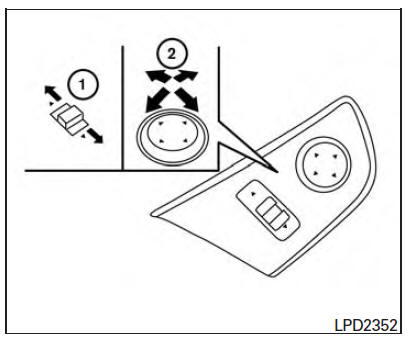
The outside mirror remote control will operate only when the ignition switch is in the ACC or ON position.
Move the small switch 1 to select the right or left mirror. Adjust each mirror to the desired position using the large switch 2 .
WARNING
- Objects viewed in the outside mirror on the passenger side are closer than they appear. Be careful when moving to the right. Using only this mirror could cause an accident. Use the inside mirror or glance over your shoulder to properly judge distances to other objects.
- Do not adjust the mirrors while driving.
You could lose control of your vehicle and cause an accident.
Reverse tilt-down feature (if so equipped)
The reverse tilt-down feature will turn both outside mirror surfaces downward to provide better rear visibility close to the vehicle when the mirror control switch is in either the L or R position.
The mirrors automatically returns to their original position when you shift out of R (Reverse).
The outside mirror surfaces will return to their original position when one of the following has occurred:
- The shift lever is moved to any position other than R (Reverse).
- The outside mirror control switch is set to the neutral or center position.
- The ignition switch is placed in the OFF position.
NOTE:
If the outside mirror control switch is in the Center position, mirror surface will NOT turn downward when the shift lever is moved to R (Reverse).
For additional information regarding this feature, refer to "Automatic drive positioner" in this section.
Foldable outside mirrors
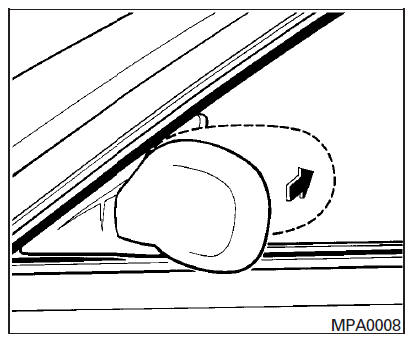
Pull the outside mirror toward the door to fold it.
Heated mirrors (if so equipped)
The electric control type outside mirrors can be heated to defrost, defog, or de-ice for improved visibility. Push the rear window defroster switch to activate the heating function. Push the switch again to deactivate, or the heating function will automatically turn off after approximately 15 minutes.
 Automatic anti-glare rearview mirror
The inside mirror is designed so that it automatically
dims during night time conditions and according
to the intensity of the headlights of the
vehicle following you. The automatic anti-glare
...
 Automatic drive positioner (if so equipped)
The automatic drive positioner system has three
features:
Memory storage function (Key-link)
Memory storage function (Switch)
Entry/exit function
Key-link, when enabled, automatically reta ...
Other materials:
SRS air bag system
"AIR BAG" Warning Lamp Does Not Turn Off
DIAGNOSTIC PROCEDURE
1.CHECK CONDITION OF AIR BAG MODULE
Inspect for any deployed air bag modules or seat belt pre-tensioners.
2.CHECK THE AIR BAG FUSE
Check 10A fuse [No. 2, located in the fuse block (J/B)].
3.CHECK AIR BAG FUSE AGAIN
Replace 10A fuse ...
B1086 - B1089 seat belt pre-tensioner LH
Description
DTC B1086 - B1089 SEAT BELT PRE-TENSIONER LH
The seat belt pre-tensioner LH is wired to the air bag diagnosis sensor unit.
The air bag diagnosis sensor unitwill monitor for opens and shorts in
detected lines to the seat belt pre-tensioner LH.
PART LOCATION
DTC Logic
DTC DETECTIO ...
C1734 control unit
Description
An internal malfunction has been detected in the TPMS function of the BCM.
DTC Logic
NOTE: The Signal Tech II Tool (J-50190) can
be used to perform the following functions. Refer to the Signal Tech II User
Guide for additional information.
Activate and display TPMS trans ...
Nissan Maxima Owners Manual
- Illustrated table of contents
- Safety-Seats, seat belts and supplemental restraint system
- Instruments and controls
- Pre-driving checks and adjustments
- Monitor, climate, audio, phone and voice recognition systems
- Starting and driving
- In case of emergency
- Appearance and care
- Do-it-yourself
- Maintenance and schedules
- Technical and consumer information
Nissan Maxima Service and Repair Manual

0.0081