
Nissan Maxima Service and Repair Manual: Front sunroof glass
Removal and Installation
REMOVAL
- Remove the wind deflector. Refer to RF-168, "Removal and Installation".
- Tape down the glass lid weatherstrip along the from sunroof glass with protective tape.
- Apply protective tape around the front sunroof glass to protect the surface from damage.
- Cut adhesive.
- Pass piano wire through the adhesive with a wire pierce.
- Tie piano wire on both ends at assist in wire grip.
- Pull piano wire with a sawing motion to cut through the adhesive.
- Remove the front sunroof glass.
INSTALLATION
WARNING:
- Keep heat and open flames away as primers and adhesive are flammable.
- The materials contained in the kit are harmful if swallowed, and may irritate skin and eyes. Never let them contact the skin or eyes.
- Use in an open, well ventilated location. Never breathe the
vapors. They may be harmful if inhaled.
Move immediately to an area with fresh air if affected by vapor inhalation.
NOTE:
- Use a genuine Nissan Urethane Adhesive Kit (if available) or an equivalent and follow the instructions furnished with it.
- Inform the customer that the vehicle should remain stationary until the urethane adhesive has completely cured (approximately 24 hours). Curing time varies with temperature and humidity.
- Using a knife or spatula, trim the adhesive (sealant) remaining on body down to approximately 2 mm thick (a) so that the contour becomes smooth.
CAUTION: If bonded area on body is scratched, be sure to repair it with a 2-component urethane. Do not use lacquer.
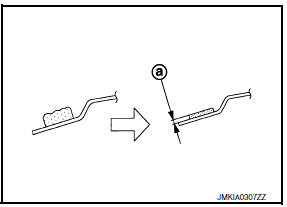
- When installing new front sunroof glass, position the front sunroof glass (no adhesive) first onto the vehicle and paint mating marks on the body and the front sunroof glass, then remove it again.
- Thoroughly clean bonding area on the front sunroof glass and the body with isopropyl alcohol or equivalent.
- Apply primer to the body and the front sunroof glass (lower) surfaces.
- Apply adhesive to the contact areas of the body within the time specified in the instructions for the adhesive.
- Open adhesive by cutting off the nozzle tip and set it in a sealant gun.
- Form a continuous bead of adhesive resembling the measurements in applied thickness (A), and in applied width (B) on the body panel.
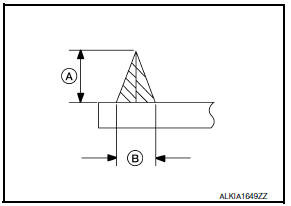
Adhesive applied thickness (A) : 13 +- 1 mm (0.51 +- 0.039 in)
Adhesive
applied width (B) : 8 +- 1 mm (0.31 +- 0.039 in)
- Position the front sunroof glass, align the paint marks and lower it into position.
- Press down lightly by hand to evenly expand the adhesive contact with the front sunroof glass.
- Using a suitable tool, remove any adhesive overflow.
- Remove the protective tape.
 Roof finisher
Removal and Installation
REMOVAL
Open the glass lid.
Apply protective tape around the roof side finisher to protect the
surface from damage.
Cut adhesive.
Pass piano wire through the ...
 Rear sunroof glass
Removal and Installation
REMOVAL
Apply protective tape around all of the glass panels to be
removed.
Remove the satellite radio antenna. Refer to AV-174, "Removal and
Installation" (Bose ...
Other materials:
Precautions on seat belt usage
If you are wearing your seat belt properly adjusted
and you are sitting upright and well back in
your seat with both feet on the floor, your chances
of being injured or killed in a collision and/or the
severity of injury may be greatly reduced.
NISSAN strongly encourages you and all of yo ...
Subwoofer
Removal and Installation
Subwoofer LH
Subwoofer RH
Subwoofer screws
Subwoofer connectors
REMOVAL
Remove the rear parcel shelf finisher. Refer to INT-36, "Removal
and Installation".
Remove the subwoofer screws.
Pull out the subwoofer, disconnect the harness c ...
CAN communication circuit
Diagnosis Procedure
1.CONNECTOR INSPECTION
Turn the ignition switch OFF.
Disconnect the battery cable from the negative terminal.
Disconnect all the unit connectors on CAN communication system.
Check terminals and connectors for damage, bend and loose
connection.
2.CHECK HARNESS CON ...
Nissan Maxima Owners Manual
- Illustrated table of contents
- Safety-Seats, seat belts and supplemental restraint system
- Instruments and controls
- Pre-driving checks and adjustments
- Monitor, climate, audio, phone and voice recognition systems
- Starting and driving
- In case of emergency
- Appearance and care
- Do-it-yourself
- Maintenance and schedules
- Technical and consumer information
Nissan Maxima Service and Repair Manual

0.0312