
Nissan Maxima Service and Repair Manual: Basic inspection
DIAGNOSIS AND REPAIR WORKFLOW
Work Flow
OVERALL SEQUENCE
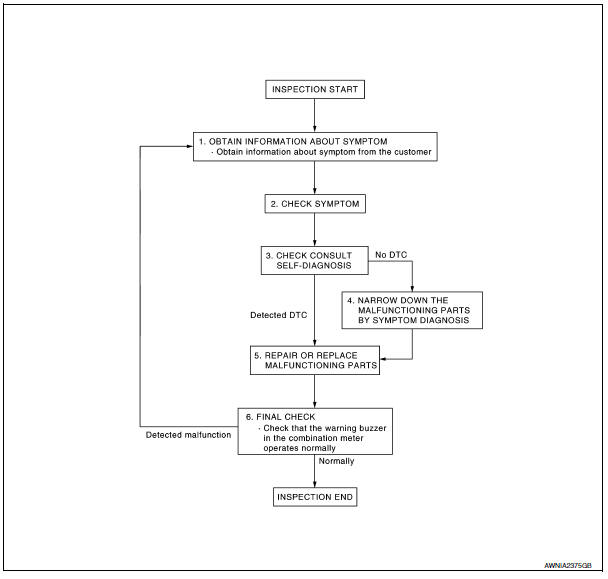
DETAILED FLOW
1.OBTAIN INFORMATION ABOUT SYMPTOM
Interview the customer to obtain as much information as possible about the conditions and environment under which the malfunction occurred.
>> GO TO 2
2.CHECK SYMPTOM
- Check the symptom based on the information obtained from the customer.
- Check to see if any other malfunctions are present.
>> GO TO 3
3.CHECK CONSULT SELF-DIAGNOSIS RESULTS
Connect CONSULT and perform "SELF-DIAGNOSIS". Refer to MWI-29, "CONSULT Function (METER/ M&A)".
4.NARROW DOWN MALFUNCTIONING PARTS THROUGH SYMPTOM DIAGNOSIS
Perform symptom diagnosis and repair or replace the identified malfunctioning parts.
>> GO TO 5
5.REPAIR OR REPLACE MALFUNCTIONING PARTS
Repair or replace malfunctioning parts.
NOTE:
If DTC is displayed, erase DTC after repairing or replacing malfunctioning parts.
>> GO TO 6
6.FINAL CHECK
Check that the warning buzzer in the combination meter operates normally.


Other materials:
Moonroof (if so equipped)
Power moonroo
The moonroof will only operate when the ignition
switch is placed in the ON position. The power
moonroof is operational for a period of time, even
if the ignition switch is placed in the ACC or OFF
position. If the driver's door or the front passenger's
door is opened during ...
Microphone
Removal and Installation
REMOVAL
Remove the map lamp assembly. Refer to INL-84, "Removal and
Installation".
Detach the microphone connector (A).
Remove the map lamp covers (1), then remove the map lamp assembly
cover (2).
Release the microphone tabs (A), then remove the micr ...
Precaution
PRECAUTIONS
Precaution for Supplemental Restraint System (SRS) "AIR BAG" and "SEAT
BELT
PRE-TENSIONER"
The Supplemental Restraint System such as "AIR BAG" and "SEAT BELT
PRE-TENSIONER", used along
with a front seat belt, helps to reduce the risk or severity of injury to ...
Nissan Maxima Owners Manual
- Illustrated table of contents
- Safety-Seats, seat belts and supplemental restraint system
- Instruments and controls
- Pre-driving checks and adjustments
- Monitor, climate, audio, phone and voice recognition systems
- Starting and driving
- In case of emergency
- Appearance and care
- Do-it-yourself
- Maintenance and schedules
- Technical and consumer information
Nissan Maxima Service and Repair Manual

0.0519