
Nissan Maxima Owners Manual: Push-Button Ignition Switch
WARNING
Do not operate the push-button ignition switch while driving the vehicle except in an emergency. (The engine will stop when the ignition switch is pushed three consecutive times in less than 1.5 seconds or the ignition switch is pushed and held for more than 2 seconds.) If the engine stops while the vehicle is being driven, this could lead to a crash and serious injury.
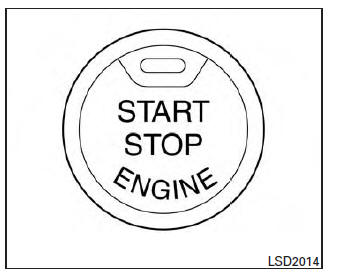
When the ignition switch is pushed without depressing the brake pedal, the ignition switch will illuminate.
If the ignition switch is in the LOCK or OFF position, push the ignition switch center:
- once to change to ACC.
- two times to change to ON.
- three times to change to OFF.
The shift lever can be moved from the P (Park) position if the ignition switch is in the ON position and the brake pedal is depressed.
If the battery of the vehicle is discharged, the push-button ignition switch cannot be moved from the LOCK position.
Some indicators and warnings for operation are displayed on the vehicle information display. For additional information, refer to "Vehicle information display" in the "Instruments and controls" section of this manual.
- Operating range
- Push-button ignition switch positions
- Emergency engine shut off
- NISSAN Intelligent Key battery discharge
- NISSAN Vehicle Immobilizer System
 Drinking alcohol/drugs and driving
WARNING
Never drive under the influence of alcohol
or drugs. Alcohol in the bloodstream reduces
coordination, delays reaction time
and impairs judgement. Driving after
drinking alcohol increases ...
 Operating range
The Intelligent Key functions can only be used
when the Intelligent Key is within the specified
operating range.
When the Intelligent Key battery is almost discharged
or strong radio waves a ...
Other materials:
BCM (body control module)
Reference Value
NOTE: The Signal Tech II Tool (J-50190) can
be used to perform the following functions. Refer to the Signal Tech II User
Guide for additional information.
Activate and display TPMS transmitter IDs
Display tire pressure reported by the TPMS transmitter
Read TPMS DTCs
Re ...
Chassis and Body Maintenance
Brake lines and cables:
Visually inspect for proper installation. Check for
chafing, cracks, deterioration, and signs of leaking.
Replace any deteriorated or damaged parts
immediately.
Brake pads, rotors, drums and linings:
Check for wear, deterioration and fluid leaks.
Replace any deteri ...
Hydraulic control system
System Diagram
System Description
The hydraulic control mechanism consists of the oil pump directly driven by
the engine, the hydraulic control
valve that controls line pressure and transmission, and the input signal lin
LINE PRESSURE AND SECONDARY PRESSURE CONTROL
When an input t ...
Nissan Maxima Owners Manual
- Illustrated table of contents
- Safety-Seats, seat belts and supplemental restraint system
- Instruments and controls
- Pre-driving checks and adjustments
- Monitor, climate, audio, phone and voice recognition systems
- Starting and driving
- In case of emergency
- Appearance and care
- Do-it-yourself
- Maintenance and schedules
- Technical and consumer information
Nissan Maxima Service and Repair Manual

0.0095