
Nissan Maxima Owners Manual: FEB system operation
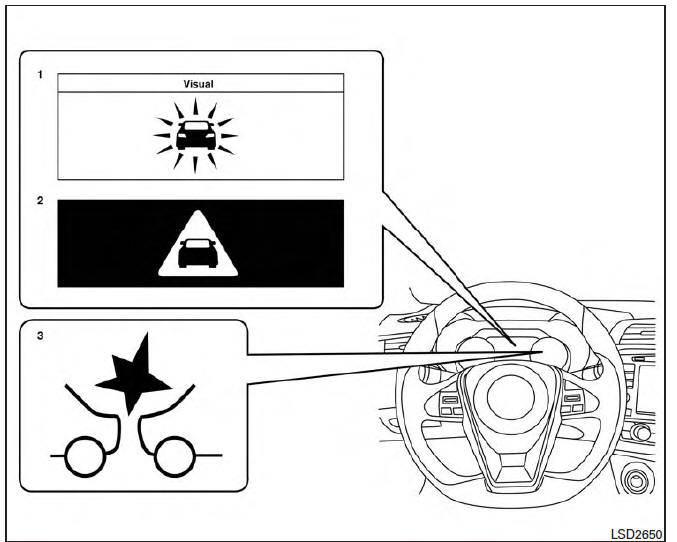
1. Vehicle ahead detection indicator
2. FEB warning indicator
3. FEB system warning light
The FEB system will function when your vehicle is driven at speeds above approximately 3 mph (5 km/h).
If a risk of a forward collision is detected, the FEB system will provide an initial warning to the driver by both a visual and audible alert.
If the driver applies the brakes quickly and forcefully after the warning, and the FEB system detects that there is still the possibility of a forward collision, the system will automatically increase the braking force. If the driver does not take action, the FEB system issues the second visual warning (red) and audible warning and also applies partial braking.
If the risk of a collision becomes imminent, the FEB system applies harder braking automatically.
NOTE:
The vehicle's brake lights come on when braking is performed by the forward emergency braking system.
Depending on vehicle speed and distance to the vehicle ahead, as well as driving and roadway conditions, the system may help the driver avoid a forward collision or may help mitigate the consequences of a collision, should one be unavoidable.
If the driver is handling the steering wheel, accelerating or braking, the FEB system will function later or will not function.
The automatic braking will cease under the following conditions:
- When the steering wheel is turned as far as necessary to avoid a collision.
- When the accelerator pedal is depressed.
- When there is no longer a vehicle detected ahead.
If the FEB system has stopped the vehicle, the vehicle will remain at a standstill for approximately 2 seconds before the brakes are released.
 Forward Emergency Braking (FEB) (if so equipped)
WARNING
Failure to follow the warnings and instructions
for proper use of the FEB system
could result in serious injury or death.
The FEB system is a supplemental aid
to the driver. It is not ...
 Turning the FEB system on/off
Perform the following steps to turn the FEB systems
ON or OFF.
1. Press the button until
"Settings" displays
in the vehicle information display and
then press OK button. Use the ...
Other materials:
Rear door speaker
Description
The audio unit sends audio signals to the rear door speakers using the rear
door speaker circuits.
Diagnosis Procedure
1.CONNECTOR CHECK
Check the audio unit and speaker connectors for the following:
Proper connection
Damage
Disconnected or loose terminals
2.HARNESS CHEC ...
P0037, P0038, P0057, P0058 HO2S2 heater
Description
SYSTEM DESCRIPTION
The ECM performs ON/OFF control of the heated oxygen sensor 2 heater
corresponding to the engine speed,
amount of intake air and engine coolant temperature.
OPERATION
DTC Logic
DTC DETECTION LOGIC
DTC CONFIRMATION PROCEDURE
1.PRECONDITIONING
If DT ...
Door switch
Description
Detects door open/close condition.
Component Function Check
1. CHECK FUNCTION
With CONSULT
Check door switches DOOR SW-DR, DOOR SW-AS, DOOR SW-RL, DOOR SW-RR in Data
Monitor mode
with CONSULT.
Diagnosis Procedure
1. CHECK DOOR SWITCH INPUT SIGNAL
Turn ignition sw ...
Nissan Maxima Owners Manual
- Illustrated table of contents
- Safety-Seats, seat belts and supplemental restraint system
- Instruments and controls
- Pre-driving checks and adjustments
- Monitor, climate, audio, phone and voice recognition systems
- Starting and driving
- In case of emergency
- Appearance and care
- Do-it-yourself
- Maintenance and schedules
- Technical and consumer information
Nissan Maxima Service and Repair Manual

0.0068