
Nissan Maxima Service and Repair Manual: Headlamp (HI) circuit
Description
The IPDM E/R (intelligent power distribution module engine room) controls the headlamp high relay based on inputs from the BCM over the CAN communication lines. When the headlamp high relay is energized, power flows through fuses 48 and 49, located in the IPDM E/R. Power then flows to the front combination lamps to the headlamp high beam.
Component Function Check
1.CHECK HEADLAMP (HI) OPERATION
WITHOUT CONSULT
- Start IPDM E/R auto active test. Refer to PCS-11, "Diagnosis Description".
- Check that the headlamp switches to the high beam.
NOTE: HI/LO is repeated 1 second each when using the IPDM E/R auto active test.
CONSULT
- Select "EXTERNAL LAMPS" of IPDM E/R active test item.
- While operating the test item, check that the headlamp switches to the high beam.
HI : Headlamp switches to the high beam.
OFF : Headlamp OFF
Diagnosis Procedure
1.CHECK HEADLAMP (HI) FUSES
- Turn the ignition switch OFF.
- Check that the following fuses are not open.

2.CHECK HEADLAMP (HI) OUTPUT VOLTAGE
CONSULT ACTIVE TEST
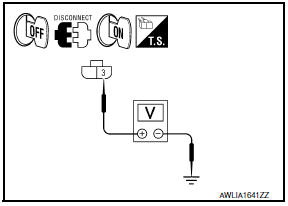
- Turn the ignition switch OFF.
- Disconnect the front combination lamp connector.
- Turn the ignition switch ON.
- Select "EXTERNAL LAMPS" of IPDM E/R active test item.
- With EXTERNAL LAMP ON, check the voltage between the combination lamp connector and ground.
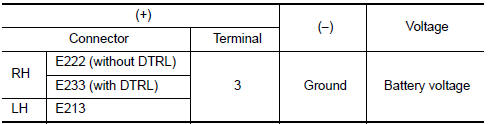
3.CHECK HEADLAMP (HI) CIRCUIT FOR OPEN
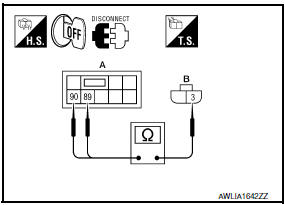
- Turn the ignition switch OFF.
- Disconnect IPDM E/R connector E200.
- Check continuity between the IPDM E/R harness connector (A) and the front combination lamp harness connector (B).
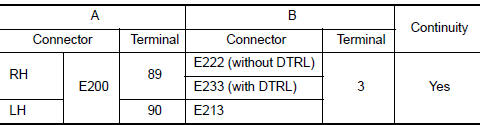
4.CHECK FRONT COMBINATION LAMP (HI) GROUND CIRCUIT
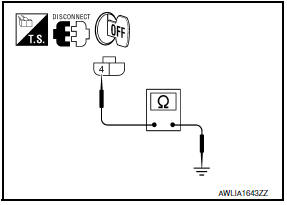
Check continuity between the front combination lamp harness connector terminal and ground.
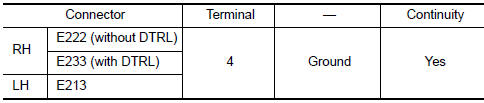
5.CHECK CONTINUITY BETWEEN FRONT COMBINATION LAMP RH (HI) AND DAYTIME LIGHT RELAY

- Disconnect daytime light relay connector.
- Check continuity between front combination lamp RH harness connector and daytime light relay harness connector.
6.CHECK DAYTIME LIGHT RELAY GROUND CIRCUIT
Check continuity between daytime light relay harness connector and ground.

7.CHECK DAYTIME LIGHT RELAY FUSE
- Turn the ignition switch OFF.
- Check that the following fuse is not open.

8.CHECK DAYTIME LIGHT RELAY CIRCUIT FOR OPEN
- Disconnect IPDM E/R connector E18 and E201.
- Check continuity between the IPDM E/R harness connector and the daytime light relay harness connector.

9.CHECK DAYTIME LIGHT RELAY
Check daytime light relay
Component Inspection
1. CHECK DAYTIME LIGHT RELAY
- Turn ignition switch OFF.
- Remove daytime light relay.
- Check the continuity between daytime light relay terminals under the following conditions.


 Power supply and ground circuit
BCM (BODY CONTROL MODULE)
BCM (BODY CONTROL MODULE) : Diagnosis Procedure
1. CHECK FUSE AND FUSIBLE LINK
Check if the following BCM fuses or fusible link are blown.
2. CHECK POWER SUPPLY CIRCU ...
 Headlamp (LO) circuit
Description
The IPDM E/R (intelligent power distribution module engine room) controls the
headlamp low relay based on inputs from the BCM over the CAN communication
lines. When the headlamp low r ...
Other materials:
Rocker Cover
Exploded View
Camshaft position sensors (LH)
O-rings
Camshaft position sensors (RH)
O-rings
Rocker cover (RH)
Rocker cover gasket (RH)
Rocker cover gasket (LH)
Rocker cover (LH)
Refer to INSTALLATION
Front
Removal and Installation (LH)
REMOVAL
Remove the ...
Hood
HOOD ASSEMBLY
HOOD ASSEMBLY : Exploded View
Hood hinge cover (LH)
Hood stay (LH)
Hood hinge (LH)
Hood assembly
Hood bumper rubber
Seal
Hood insulator
Hood insulator clips
HOOD ASSEMBLY : Removal and Installation
CAUTION:
Use two people when removing or installi ...
P0197, P0198 EOT sensor
Description
The engine oil temperature sensor is used to detect the engine oil
temperature. The sensor modifies a voltage signal from the ECM.
The modified signal returns to the ECM as the engine oil temperature
input. The sensor uses a thermistor which is sensitive to the
change in te ...
Nissan Maxima Owners Manual
- Illustrated table of contents
- Safety-Seats, seat belts and supplemental restraint system
- Instruments and controls
- Pre-driving checks and adjustments
- Monitor, climate, audio, phone and voice recognition systems
- Starting and driving
- In case of emergency
- Appearance and care
- Do-it-yourself
- Maintenance and schedules
- Technical and consumer information
Nissan Maxima Service and Repair Manual

0.007