
Nissan Maxima Owners Manual: Starting the vehicle
1. After starting the engine, fully depress the foot brake pedal before moving the shift lever out of the P (Park) position.
2. Keep the foot brake pedal depressed and move the shift lever into a driving gear.
3. Release the parking brake and the foot brake pedal, then gradually start the vehicle in motion.
4. Stop the vehicle completely before shifting the shift lever to the P (Park) position.
The CVT is designed so the foot brake pedal MUST be depressed before shifting from P (Park) to any drive position while the ignition switch is in the ON position.
The shift lever cannot be moved out of P (Park) and into any of the other gear positions if the ignition switch is pushed to the LOCK position.
WARNING
- Do not depress the accelerator pedal
while shifting from P (Park) or N (Neutral)
to R (Reverse), D (Drive), or M
(Manual shift mode). Always depress
the brake pedal until shifting is completed.
Failure to do so could cause you to lose control and have an accident. It can also damage the vehicle.
- Cold engine idle speed is high, so use caution when shifting into a forward or reverse gear before the engine has warmed up.
- Do not downshift abruptly on slippery roads. This may cause a loss of control.
- Never shift to either the P (Park) or R
(Reverse) position while the vehicle is
moving forward and P (Park) or D
(Drive) position while the vehicle is reversing.
This could cause an accident or damage the transmission.
CAUTION
- Except in an emergency, do not shift to
the N (Neutral) position while driving.
Coasting with the transmission in the N (Neutral) position may cause serious damage to the transmission.
- To avoid possible damage to your vehicle, when stopping the vehicle on an uphill grade, do no hold the vehicle by depressing the accelerator pedal. The foot brake should be used for this purpose.
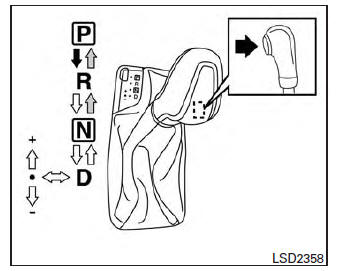
To move the shift lever:
 Press the button while depressing
the brake
pedal
Press the button while depressing
the brake
pedal
 Press the button to shift
 Shift without pressing button
 Driving the vehicle
Continuously Variable Transmission (CVT)
WARNING
Do not depress the accelerator pedal
while shifting from P (Park) or N (Neutral)
to R (Reverse), D (Drive), or M
(Manual shift mode). Al ...
 Shifting
After starting the engine, fully depress the brake
pedal and move the shift lever from P (Park) to
any of the desired shift positions.
WARNING
Apply the parking brake if the shift lever is
in any ...
Other materials:
Door request switch
Description
Transmits door lock/unlock operation to BCM.
Component Function Check
1. CHECK FUNCTION
With CONSULT
Check door request switch REQ SW-DR, REQ SW-AS in Data Monitor mode.
Diagnosis Procedure
1. CHECK DOOR REQUEST SWITCH OUTPUT SIGNAL
Turn ignition switch OFF.
Check ...
Precaution
Precaution for Supplemental Restraint System (SRS) "AIR BAG" and
"SEAT BELT PRE-TENSIONER"
The Supplemental Restraint System such as "AIR BAG" and "SEAT BELT
PRE-TENSIONER", used along with a front seat belt, helps to reduce the risk
or severity of injury to the driver and front passenger for ...
Checking engine oil level
1. Park the vehicle on a level surface and apply
the parking brake.
2. Start the engine and let it idle until it reaches
operating temperature.
3. Turn off the engine. Wait more than
10 minutes for the oil to drain back into
the oil pan.
4. Remove the dipstick and wipe it clean. Rei ...
Nissan Maxima Owners Manual
- Illustrated table of contents
- Safety-Seats, seat belts and supplemental restraint system
- Instruments and controls
- Pre-driving checks and adjustments
- Monitor, climate, audio, phone and voice recognition systems
- Starting and driving
- In case of emergency
- Appearance and care
- Do-it-yourself
- Maintenance and schedules
- Technical and consumer information
Nissan Maxima Service and Repair Manual

0.0077