
Nissan Maxima Service and Repair Manual: Compression Pressure
On-Vehicle Service
CHECKING COMPRESSION PRESSURE
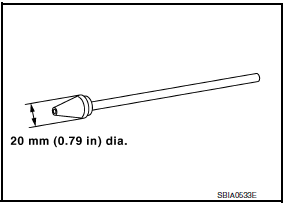
- Run the engine until it reaches normal operating temperature.
- Turn the ignition switch to OFF.
- Release fuel pressure. Refer to EC-592, "Inspection".
- Remove all six spark plugs.
Refer to EM-12, "Removal and Installation".
- Attach a compression tester to No. 1 cylinder.
- Depress accelerator pedal fully to keep the electric throttle control actuator butterfly-valve wide open to maximize air intake flow.
- Crank the engine and record the highest gauge indication.
- Repeat the measurement on each cylinder (steps 5 - 7).

- Always use a fully-charged battery to obtain specified engine speed.
- If the engine speed is out of the specified range check the battery and recharge as necessary. Check the engine speed again with the battery properly charged.
- If some cylinders have low compression pressure, pour a small amount of engine oil into the spark plug hole of the cylinder to re-check it for compression.
- If the added engine oil improves the compression, piston rings may be worn out or damaged. Check the piston rings and replace if necessary
- If the compression pressure remains at low level despite the addition of engine oil, the valves may be malfunctioning. Check the valves for damage. Replace the valve or valve seat accordingly.
- If two adjacent cylinders have respectively low compression pressure and their compression remains low even after the addition of engine oil, cylinder head gaskets may be leaking, or a valve in adjacent cylinders may be damaged. Inspect and repair as required.
- If the compression pressure is below the minimum value, check the valve clearances and parts associated with the combustion chamber (valve, valve seat, piston, piston ring, cylinder bore, cylinder head, cylinder head gasket). After the checking, measure the compression pressure again.
 Camshaft Valve Clearance
Valve Clearance
CHECKING
NOTE:
Perform inspection as follows after removal, installation or
replacement of camshaft or valve related parts, or if there are unusual
engine conditions rega ...

Other materials:
P0420, P0430 three way catalyst function
DTC Logic
DTC DETECTION LOGIC
The ECM monitors the switching frequency ratio of air fuel ratio (A/F)
sensor 1 and heated oxygen sensor 2.
A three way catalyst (manifold) with high oxygen storage capacity
will indicate a low switching frequency of heated oxygen sensor 2.
As oxygen sto ...
P0455 evap control system
DTC Logic
DTC DETECTION LOGIC
This diagnosis detects a very large leakage (fuel filler cap fell off etc.)
in EVAP system between the fuel tank
and EVAP canister purge volume control solenoid valve.
CAUTION:
Use only a genuine NISSAN fuel filler cap as a replacement. If
an ...
How to park with predicted course lines
WARNING
If the tires are replaced with different
sized tires, the predicted course lines
may be displayed incorrectly.
On a snow-covered or slippery road,
there may be a difference between the
predicted course line and the actual
course line.
If the battery is disconnected or becomes
discha ...
Nissan Maxima Owners Manual
- Illustrated table of contents
- Safety-Seats, seat belts and supplemental restraint system
- Instruments and controls
- Pre-driving checks and adjustments
- Monitor, climate, audio, phone and voice recognition systems
- Starting and driving
- In case of emergency
- Appearance and care
- Do-it-yourself
- Maintenance and schedules
- Technical and consumer information
Nissan Maxima Service and Repair Manual

0.0106