
Nissan Maxima Service and Repair Manual: P0116 ECT sensor
Description
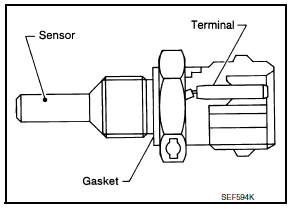
The engine coolant temperature sensor is used to detect the engine coolant temperature. The sensor modifies a voltage signal from the ECM. The modified signal returns to the ECM as the engine coolant temperature input. The sensor uses a thermistor which is sensitive to the change in temperature. The electrical resistance of the thermistor decreases as temperature increases.
<Reference data>
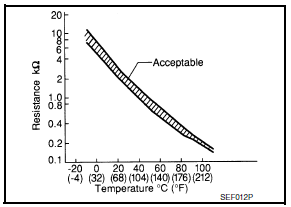
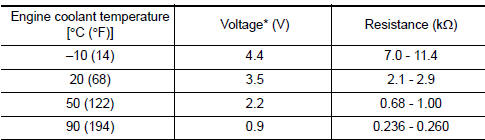
*: These data are reference values and are measured between ECM terminals 46 (Engine coolant temperature sensor) and 52 (Sensor ground).
DTC Logic
DTC DETECTION LOGIC
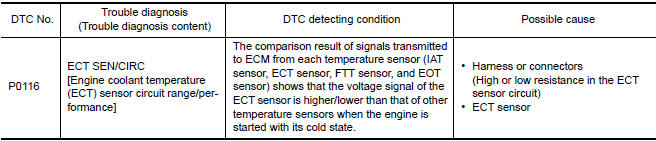
DTC CONFIRMATION PROCEDURE
1.INSPECTION START
2.PERFORM COMPONENT FUNCTION CHECK
Perform component function check. Refer to EC-202, "Component Function Check".
NOTE: Use the component function check to check the overall function of the ECT sensor circuit. During this check, a 1st trip DTC might not be confirmed.
3.PRECONDITIONING
If DTC CONFIRMATION PROCEDURE has been previously conducted, always perform the following procedure before conducting the next test.
- Turn ignition switch OFF and wait at least 10 seconds.
- Turn ignition switch ON.
- Turn ignition switch OFF and wait at least 10 seconds.
TESTING CONDITION:
- Before performing the following procedure, do not add fuel.
- Before performing the following procedure, check that fuel level is between 1/4 and 4/4.
- Before performing the following procedure, confirm that battery voltage is 11 V or more at idle.
4.PERFORM DTC CONFIRMATION PROCEDURE
- Start engine and let it idle for 60 minutes.
- . Move the vehicle to a cool place. NOTE: Cool the vehicle in an environment of ambient air temperature between −10C (14F) and 35C (95F).
- Turn ignition switch OFF and soak the vehicle for 12 hours.
CAUTION:
Never turn ignition switch ON during soaking.
NOTE: The vehicle must be cooled with the food open.
- Start engine and let it idle for 5 minutes or more. CAUTION: Never turn ignition switch OFF during idling.
- Check 1st trip DTC.
Component Function Check
1.CHECK ENGINE COOLANT TEMPERATURE (ECT) SENSOR
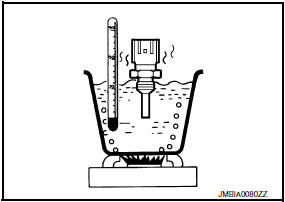
- Turn ignition switch OFF.
- Disconnect ECT sensor harness connector.
- Remove ECT sensor. Refer to CO-24, "Removal and Installation".
- Check resistance between ECT sensor terminals by heating with hot water as shown in the figure.
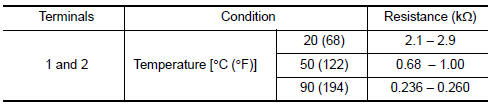
2.CHECK INTERMITTENT INCIDENT
Check intermittent incident
Diagnosis Procedure
1.CHECK ENGINE COOLANT TEMPERATURE (ECT) SENSOR
Check ECT sensor
2.CHECK INTERMITTENT INCIDENT
Check intermittent incident
Component Inspection
1.CHECK ENGINE COOLANT TEMPERATURE SENSOR
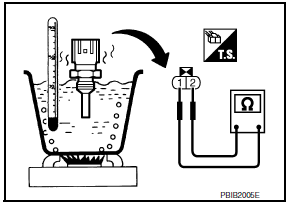
- Turn ignition switch OFF.
- Disconnect engine coolant temperature sensor harness connector.
- Remove engine coolant temperature sensor. Refer to CO-24, "Removal and Installation".
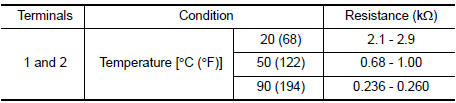
- Check resistance between engine coolant temperature sensor terminals as per the following.
 P0112, P0113 IAT sensor
Description
The intake air temperature sensor is built-into the mass air flow sensor
(1). The sensor detects intake air temperature and transmits a
signal to the ECM.
The temperature sensing ...
 P0117, P0118 ECT sensor
Description
The engine coolant temperature sensor is used to detect the engine
coolant temperature. The sensor modifies a voltage signal from the
ECM. The modified signal returns to the ECM a ...
Other materials:
Air cleaner
The air cleaner filter should not be cleaned and
reused. Replace it according to the maintenance
log shown in the "Maintenance and schedules"
section of this manual. When replacing the filter,
wipe the inside of the air cleaner filter housing
and the cover with a damp cloth.
To remove the ...
Precaution
Precaution for Supplemental Restraint System (SRS) "AIR BAG" and "SEAT
BELT
PRE-TENSIONER"
The Supplemental Restraint System such as "AIR BAG" and "SEAT BELT PRE-TENSIONER",
used along
with a front seat belt, helps to reduce the risk or severity of injury to the
driver ...
B257B, B257C ambient sensor
Description
COMPONENT DESCRIPTION
Ambient Sensor
The ambient sensor (1) is installed to the front bumper
reinforcement.
It detects ambient temperature and converts it into a resistance
value which is then input into the A/C auto amp.
Ambient Sensor Circuit
AMBIENT TEMPERATUR ...
Nissan Maxima Owners Manual
- Illustrated table of contents
- Safety-Seats, seat belts and supplemental restraint system
- Instruments and controls
- Pre-driving checks and adjustments
- Monitor, climate, audio, phone and voice recognition systems
- Starting and driving
- In case of emergency
- Appearance and care
- Do-it-yourself
- Maintenance and schedules
- Technical and consumer information
Nissan Maxima Service and Repair Manual

0.0182