
Nissan Maxima Service and Repair Manual: C1142 press sen circuit
Description
The pressure sensor converts the brake fluid pressure to an electric signal and transmits it to the ABS actuator and electric unit (control unit). (The pressure sensor is integrated in the ABS actuator and electric unit (control unit).)
DTC Logic
DTC DETECTION LOGIC

DTC CONFIRMATION PROCEDURE
1.CHECK SELF-DIAGNOSIS RESULTS
Check the self-diagnosis results.

Diagnosis Procedure
1.CONNECTOR INSPECTION
- Turn ignition switch OFF.
- Disconnect ABS actuator and electric unit (control unit) connector and stop lamp switch connector.
- Check terminals for deformation, disconnection, looseness and damage. If any malfunction is found, repair or replace terminals.
- Reconnect connectors securely.
- Start engine.
- Pump brake pedal carefully several times, and perform self-diagnosis.
2.CHECK STOP LAMP SWITCH
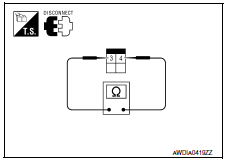
- Turn ignition switch OFF.
- Disconnect stop lamp switch connector.
- Check continuity between stop lamp switch terminals 3 and 4.

3.CHECK STOP LAMP SWITCH CIRCUIT
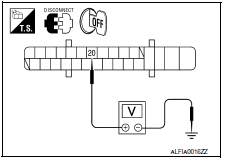
- Disconnect ABS actuator and electric unit (control unit) connector.
- Connect stop lamp switch connector.
- Check voltage between ABS actuator and electric unit (control unit) connector E26 terminal 20 and ground.
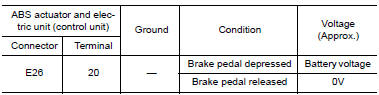
4.CHECK SELF-DIAGNOSIS RESULTS
Check self-diagnosis results.

Component Inspection
1.CHECK DATA MONITOR
On "DATA MONITOR", select "PRESS SENSOR" and check the brake fluid pressure.

Special Repair Requirement
1.ADJUSTMENT OF STEERING ANGLE SENSOR NEUTRAL POSITION
Always perform the neutral position adjustment for the steering angle sensor, when replacing the ABS actuator and electric unit (control unit).
 C1130, C1131, C1132, C1133, C1136 engine signal
Description
ABS actuator and electric unit (control unit) and ECM exchange the engine
signal with CAN communication
line.
DTC Logic
DTC DETECTION LOGIC
DTC CONFIRMATION PROCEDURE
1.CHECK ...
 C1143, C1144 steering angle sensor
Description
The steering angle sensor detects the rotation amount, angular velocity and
direction of the steering wheel,
and transmits the data to the ABS actuator and electric unit (control unit ...
Other materials:
Measurement of weights
Secure loose items to prevent weight
shifts that could affect the balance of your
vehicle. When the vehicle is loaded, drive
to a scale and weigh the front and the rear
wheels separately to determine axle
loads. Individual axle loads should not exceed
either of the gross axle weight ratings
( ...
Changing engine coolant
A NISSAN dealer can change the engine coolant.
The service procedure can be found in the
NISSAN Service Manual.
Improper servicing can result in reduced
heater performance and engine overheating.
WARNING
To avoid the danger of being scalded,
never change the coolant when the engine
is ...
Changing wheels and tires
Tire rotation
NISSAN recommends rotating the tires
every 5,000 miles (8,000 km).
For additional information on tire replacing
procedures, refer to "Flat tire" in the "In
case of emergency" section of this
manual.
As soon as possible, tighten the
wheel nuts to the specified torque
with ...
Nissan Maxima Owners Manual
- Illustrated table of contents
- Safety-Seats, seat belts and supplemental restraint system
- Instruments and controls
- Pre-driving checks and adjustments
- Monitor, climate, audio, phone and voice recognition systems
- Starting and driving
- In case of emergency
- Appearance and care
- Do-it-yourself
- Maintenance and schedules
- Technical and consumer information
Nissan Maxima Service and Repair Manual

0.0101