
Nissan Maxima Service and Repair Manual: Occupant classification system
System Diagram
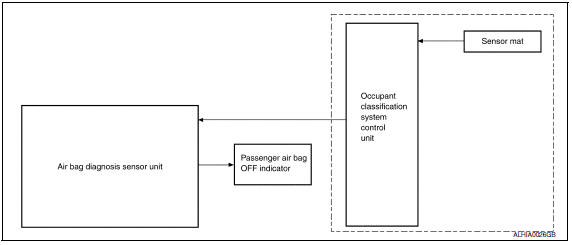
Occupant Classification System (OCS)
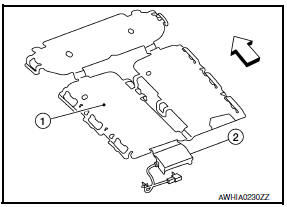
The occupant classification system (OCS) identifies if a child or child
seat is present in the front passenger seat. The OCS receives inputs
from the
occupant classification sensor mat (1) which is located
inside the passenger
seat cushion assembly. Depending on classification
of the passenger, the OCS
control unit (2) sends a signal to
the air bag diagnosis sensor unit. The air
bag diagnosis sensor unit
uses this signal and the seat belt buckle switch RH
signal to determine
deployment or non-deployment of the front passenger air
bag
module in the event of a collision. Depending on the signals
received,
the air bag diagnosis sensor unit can disable the front passenger
air bag
module completely.
NOTE:
In case of
customer concern, CONSULT can be used to confirm the front passenger air bag
status (readiness).
Front Passenger Air Bag Status Conditions

NOTE:
Passenger does not meet Occupant Classification
System specifications for passenger air bag activation.
 SRS air bag system
SRS Configuration
The air bag deploys if the air bag diagnosis sensor unit is activated while
the ignition switch is in the ON orSTART position.The collision modes
for which supplemental restra ...
 Passenger seat belt warning system
System Diagram
System Description
The seat belt warning lamp (1) will remind the driver if the driver or
front passenger seat belt should be buckled. The system works inconjunction
with the o ...
Other materials:
P0456 evap control system
DTC Logic
DTC DETECTION LOGIC
NOTE:
If DTC P0456 is displayed with DTC P0442, first perform the trouble diagnosis
for DTC P0456.
This diagnosis detects very small leakage in the EVAP line between fuel tank
and EVAP canister purge volume
control solenoid valve, using the intake manifold va ...
Removal and installation
SUNROOF UNIT ASSEMBLY
Inspection
WIND DEFLECTOR
Open glass lid assembly fully.
Visually check for proper installation, damaged/deteriorated
components, or foreign objects within mechanism.
Correct as required for
smooth operation.
Check for grease at the wind deflector arm (1) and ...
System description
CLIMATE CONTROLLED SEAT SYSTEM
System Diagram
System Description
The climate controlled seat system is controlled by the climate
controlled seat control unit.
Operation of the climate controlled seat switch sends heated or
cooled airflow and adjusts the seat temperature.
SEAT CUS ...
Nissan Maxima Owners Manual
- Illustrated table of contents
- Safety-Seats, seat belts and supplemental restraint system
- Instruments and controls
- Pre-driving checks and adjustments
- Monitor, climate, audio, phone and voice recognition systems
- Starting and driving
- In case of emergency
- Appearance and care
- Do-it-yourself
- Maintenance and schedules
- Technical and consumer information
Nissan Maxima Service and Repair Manual

0.0094